
As Canadians embrace smart home upgrades, homeowners across the GTA and Niagara region are replacing traditional fixtures with connected lighting, security systems, and automated controls. From smart pot lights and voice-activated speakers to ceiling-mounted sensors and Wi-Fi access points, modern homes increasingly rely on technology that integrates directly into the ceiling.
Yet one hidden obstacle often stands in the way of seamless smart home integration: textured ceilings.
Whether it is stipple, knock-down, or the classic “cottage cheese” popcorn finish, these outdated ceiling textures are more than a cosmetic issue. They can directly interfere with installation quality, device accuracy, lighting performance, and long-term upgrade flexibility.
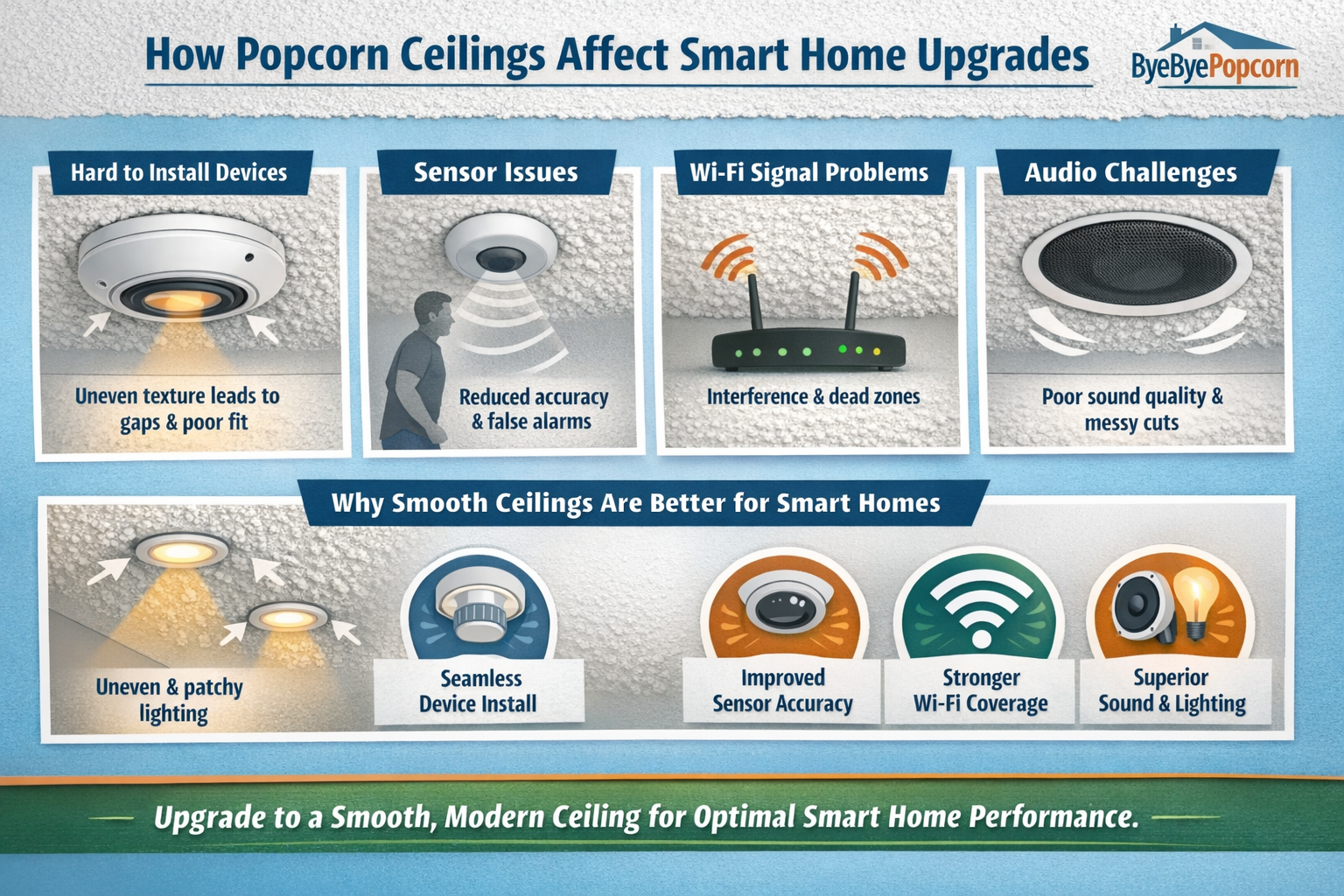
Why Popcorn Ceilings Make Flush-Mount Smart Devices Hard to Install
Most modern smart home devices are designed with clean, minimalist profiles that assume a flat mounting surface. Smart smoke detectors, ceiling-mounted sensors, and flush-mount smart lighting fixtures are engineered to sit tightly against smooth drywall.
On popcorn ceilings, the uneven texture prevents a proper seal. This creates visible gaps, uneven shadowing, and an unfinished appearance. Over time, these gaps attract dust and cobwebs, which are already common issues in Ontario homes with textured ceilings. In many cases, installers must rely on spacers or custom mounting solutions, which increase labour time and compromise aesthetics.
How Popcorn Ceilings Reduce Motion Sensor and Security Accuracy
Smart security and automation systems depend on precision. Motion sensors and occupancy detectors must be mounted at specific angles to detect movement reliably across a space.
The peaks and valleys of popcorn ceilings can obstruct infrared detection or subtly tilt ceiling-mounted sensors. This can lead to false triggers, delayed responses, or blind spots in detection. For homeowners relying on automation for security, lighting control, or energy efficiency, these inconsistencies reduce confidence in the system and undermine the purpose of smart technology.
Can Popcorn Ceilings Interfere with Smart Home Signals?
Popcorn ceilings do not fully block Wi-Fi, Zigbee, or Z-Wave signals, but they can still affect signal performance in a home.
When ceiling-mounted Wi-Fi mesh nodes or access points are installed in homes throughout areas such as Woodbridge or Ancaster, signal distribution is more predictable with a smooth Level 5 ceiling finish. Popcorn texture can scatter signals slightly, contributing to uneven coverage and hard-to-diagnose dead zones.
Why Popcorn Ceilings Are a Problem for In-Ceiling Smart Audio
In-ceiling smart speakers and whole-home audio systems are increasingly popular for homeowners who want technology to blend seamlessly into their living space. Installing these systems in popcorn ceilings often creates avoidable challenges.
Cutting into textured drywall causes the surrounding material to crumble and flake, making it difficult to achieve a clean finish around speaker grilles. While popcorn ceilings were once marketed as “acoustic,” they actually absorb and dull sound. Smooth ceilings reflect audio more accurately, delivering clearer dialogue, better music fidelity, and a noticeably improved listening experience.
How Popcorn Ceilings Ruin Smart Lighting Effects
Smart lighting is designed to create controlled ambiance, scenes, and layered illumination. Smart LED pot lights, tunable white fixtures, and colour-changing systems perform best when light spreads evenly across a smooth surface.
On popcorn ceilings, the uneven texture creates thousands of tiny shadows. This produces a jagged, inconsistent glow that makes even premium smart lighting appear dimmer and less refined. Instead of clean light distribution, homeowners often see patchy illumination that undermines the modern look they were aiming for.
When to Remove Popcorn Ceilings During Smart Home Renovations
Timing matters when upgrading a smart home. Removing popcorn ceilings before installing ceiling-mounted devices prevents unnecessary rework and protects your investment.
Popcorn ceiling removal is best completed before installing smart lighting, adding new wiring, mounting sensors, or upgrading ceiling speakers. Addressing the ceiling first allows installers to work on a clean, stable surface and reduces the risk of damaging newly installed technology. It also ensures that paint, fixtures, and automation components all align with a modern finish from the start.
DIY vs Professional Popcorn Ceiling Removal for Smart Homes
Some homeowners consider removing popcorn ceilings themselves, especially when planning renovations. While DIY removal may seem cost-effective, smart homes introduce additional risks.
Textured ceilings often conceal wiring, junction boxes, and previous patchwork. Improper scraping can damage electrical components or compromise ceiling integrity. Dust generated during removal can also affect smart home hubs, networking equipment, and sensitive electronics.
Professional removal uses dust-controlled systems and proper surface preparation to protect both the home and its technology. For smart homes that require precise installation and clean finishes, professional removal typically delivers far better results.
Cost Considerations: Removal vs Installation Workarounds
Leaving popcorn ceilings in place can increase the cost of smart home upgrades over time. Installers may charge more to compensate for uneven surfaces, additional mounting hardware, or ceiling repairs caused during installation.
In contrast, removing popcorn ceilings creates a smooth foundation that simplifies future upgrades. Homeowners often find that removal reduces overall renovation friction and prevents repeated patching or reinstallation costs as technology evolves.
Popcorn Ceilings in Older Canadian Homes
Many older Canadian homes still feature popcorn ceilings, particularly in properties built or renovated decades ago. These ceilings often hide surface imperfections, outdated wiring layouts, or inconsistent drywall finishing.
When upgrading to smart technology, these hidden issues can surface unexpectedly during installation. Removing the texture fully exposes the ceiling, enabling proper inspection, repair, and modernization before advanced systems are installed.
Popcorn Ceilings vs Smooth Ceilings for Smart Homes
Smooth ceilings provide the ideal foundation for smart home technology. Devices mount securely, lighting spreads evenly, sensors function accurately, and connectivity performs more predictably.
Popcorn ceilings introduce friction at every stage, from installation challenges to ongoing performance limitations. For homeowners investing in automation, removal is not just an aesthetic decision—it is a functional upgrade that supports better results across the entire smart home ecosystem.
Creating a Smooth Foundation for Smart Home Technology
If you are investing in smart home upgrades, outdated ceilings should not hold your home back. Preparing the ceiling properly ensures that technology installs cleanly and performs as intended.
At ByeByePopcorn, popcorn ceiling removal is completed using dust-controlled scraping with the Festool System, followed by a Level 5 finish that creates a perfectly smooth surface. This process minimizes disruption while creating a ceiling that supports modern lighting, sensors, audio, and connectivity.
Frequently Asked Questions
Can I install smart pot lights in a popcorn ceiling?
Yes, but the results are often disappointing. Popcorn texture creates uneven light spread, visible shadows, and “hot spots.” Removing the texture first allows smart LED lighting to distribute evenly and look significantly more refined.
Does popcorn ceiling removal create dust that can damage electronics?
Traditional removal methods can be messy, but ByeByePopcorn uses the Festool dust-extraction system. Dust is captured at the source, making the process safer for homes with smart hubs, networking equipment, and sensitive electronics.
Why is a Level 5 finish important for smart homes?
A Level 5 finish is the highest drywall standard. It creates a perfectly flat surface that reflects light evenly and allows ceiling-mounted smart devices to sit flush without gaps or alignment issues.
Will removing popcorn ceilings improve Wi-Fi performance?
Removing popcorn ceilings will not replace a quality router or mesh system. However, smooth ceilings reflect signals more predictably and allow cleaner installation of ceiling-mounted access points, which can improve overall coverage consistency.